

5 Steps to Build a Bid Storyboard for UK Tenders With Mixed Criteria
What is a bid writing storyboard for UK tenders with mixed criteria?
A bid storyboard for UK tenders is a one-page planning tool that maps your tender response before anyone starts drafting. It turns the ITT questions, scoring criteria, and weightings into a clear structure so your team knows what to say, where to say it, and what evidence to use.
For UK tenders with mixed criteria such as quality, price, and social value, a bid storyboard keeps responses focused on marks rather than narrative. Instead of writing long answers and hoping they score well, the storyboard links each section of the response to the relevant scoring criteria, weighting, and supporting proof.
In practice, a one-page bid storyboard helps teams prioritise the highest-scoring points, organise evidence, and maintain consistency across multiple contributors.
In this post, you’ll learn what to include in a bid storyboard for UK tenders, how to build one quickly, how to handle mixed evaluation criteria, and what to avoid when scoring priorities pull in different directions.
Why this matters when criteria are mixed (and time is tight)
Mixed criteria tenders are where strong delivery teams get caught out.
Not because they don’t have a good service, but because they explain it in the wrong shape.
One question asks for your mobilisation plan (quality). Another wants a pricing schedule (commercial). Another asks for social value (community, jobs, carbon). Each section is judged differently, often by different people, sometimes with different scoring rubrics.
So your bid ends up like a group project. Everyone worked hard, but nobody owned the storyline.
A one-page storyboard fixes that because it forces you to decide, early:
- what the evaluator needs to see to award marks,
- what you will prove (not just claim),
- who owns each piece of evidence,
- how price and quality support each other (rather than quietly contradict).
If you’ve ever read a rejection note and thought, “We do that, we just didn’t say it”, this is the preventative step.
If a point can’t be scored quickly, it’s not a point yet. It’s a nice idea with no marks attached.
For a general primer on the concept, see storyboarding bids: how to start.
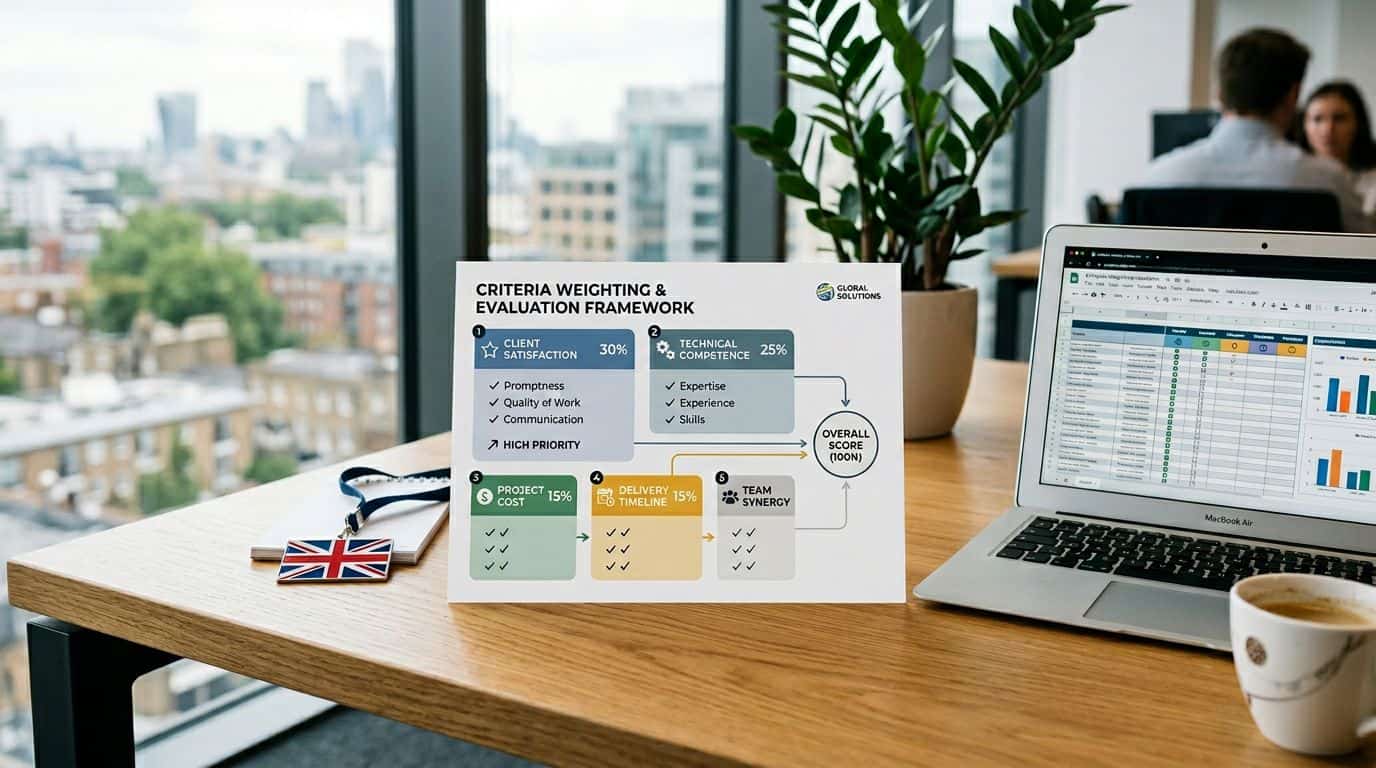
The one-page layout that keeps evaluators on your side

Photo by PNW Production
Think of the storyboard as your bid’s sat-nav. It doesn’t drive the car for you, but it stops “we’ll just see how we get on” turning into a late-night detour.
On one page, aim to capture six blocks.
1) The scoring map (your non-negotiable start)
Write the criteria and weightings in plain view. Include pass/fail items too.
You’re telling the truth to the team up front: “This is where the marks live.”
2) The win themes (three short phrases)
These are your repeatable reasons to choose you. Keep them concrete, not fluffy.
Examples: “Fast mobilisation with named leads”, “measured outcomes with live reporting”, “low-risk delivery backed by evidence”.
3) The proof bank (evidence only)
List the case studies, metrics, certificates, policies, CVs, and references you will use.
If you can’t source it, don’t build a paragraph around it.
4) The method headline per question
One sentence each without jargon or waffle. This becomes the topic sentence of your final answer.
5) The “price story”
This is the logic behind the numbers. What drives cost, what reduces risk, what’s included, what’s controlled.
6) Social value, aligned to delivery
Pick commitments you can actually deliver, measure, and report.
To make this practical, use a tiny table like this in your storyboard (it fits on one page if you keep it tight):
| Criterion | Weight | What they can award marks for | Your proof | Owner |
|---|---|---|---|---|
| Service delivery method | 40% | Clear steps, roles, controls, timescales | Mobilisation plan, org chart, KPI set | Ops lead |
| Price | 30% | Transparent build-up, value for money | Pricing notes, assumptions, cost drivers | Finance |
| Social value | 10% | Specific commitments, measurement | SV plan, targets, reporting approach | CSR lead |
| Quality and compliance | 20% | Policies applied in practice | ISO, training logs, audits, case study | QHSE |
The takeaway: you’re not filling boxes, you’re assigning marks to people and proof to deadlines.
How to build your one-page storyboard in 45 minutes (without a workshop)
You need a repeatable process, not a perfect one.
Start with the tender documents open, then run this short sequence. Keep it brisk. Momentum beats artistry.
Step 1: Translate every question into “they want to see…”
This is where bids are won. Don’t copy the question back in different words. Convert it into a marking lens.
→ What will a “5 out of 5” answer contain?
→ What would make an evaluator hesitate?
→ What would a weaker bidder say that you won’t?
Step 2: Match each question to one win theme
If a question doesn’t connect to a win theme, it becomes a random paragraph.
→ Which theme does this support?
→ What’s the single point you want remembered?
Step 3: Attach proof to each claim
Make it awkwardly specific.
→ What document proves it?
→ What metric shows it works?
→ What example shows it’s routine, not a one-off?
Step 4: Check for mixed-criteria clashes
This is the hidden leak in many bids.
For example, your quality answer promises weekly site visits, but your price looks like it funds monthly visits. Or your social value claims add workload your team hasn’t costed.
→ Does the pricing approach support the delivery method?
→ Do your KPIs match your staffing model?
→ Can you measure every social value promise?
Step 5: Decide your evaluator-friendly structure
Before drafting, choose a format you’ll repeat.
A simple pattern works well: short heading, direct answer, method, proof, measures, then a neat close.
This is also where teams feel calmer. You stop starting from a blank page, and you stop rewriting the same section three times because it “doesn’t feel right”.
Common mistakes that lose marks (even when your service is strong)
Most bid issues aren’t big. They’re small, repeated, and expensive in scoring.
Mixing evidence into the wrong places
Case studies drift into policy questions. Policies appear where a method statement was needed. Evaluators then hunt for proof, and they won’t always bother.
Writing for humans, not for markers
Warm, persuasive writing is fine, but it still has to be easy to score. Headings, signposting, and measurable statements matter.
Treating price as separate from quality
In mixed criteria tenders, price is rarely “just maths”. It’s credibility. A good storyboard makes cost and method reinforce each other.
Over-promising social value
Evaluators like ambition, but they score delivery confidence. Promise fewer things, then measure them well.
A one-page storyboard should reduce writing, not create a new admin task. If it’s taking hours, you’re building a second bid.
A calmer way to finish: review the storyboard like an evaluator would
By the time you draft, you’re tired. Everyone’s busy. Nobody wants a theory lesson.
That’s why the storyboard is so useful. It gives you a quick test before you commit days of writing time.
At Bidsmithery™, the approach is built around this idea: your team stays in control, and the bid gets shaped using evaluator logic, so the final draft is easier to read and easier to score. Over time, teams get quicker, rejection reasons get rarer, and deadlines stop stealing evenings.
If you want support without handing the whole bid over, a bid review retainer can work well because it keeps help available when opportunities land, rather than paying per panic. If you need full writing, there are also models where the risk is shared, including no-win, no-fee structures, so effort is tied to outcome.
Either way, start with the one page. It’s the simplest fix you’ll wish you’d used sooner.
If you’d like a straight answer on what will improve your next submission, book a fit check call. If you’re building internal skills, ask about the Bid Win Rate Accelerator Training. If you’re close to submission, ask about bid review support. Your next bid should feel clearer than your last, and it can.

Meet the Author
Melissa is the founder of Bidsmithery™ with over 15 years of experience across bid writing, bid management and evaluation. Having sat on both sides of the process as both writer and evaluator, she works across sectors because great bids follow the same principles wherever you’re tendering. With more than £103M in contracts secured, she specialises in framework bids and strategic bid reviews helping organisations sharpen their approach when it really counts.






One Comment
Comments are closed.