


How to Answer Conflict of Interest Statements (Without Overthinking It)
What are conflict of interest statements?
A buyer may ask a supplier to provide a UK tender conflict of interest declaration. The requirement comes from the live tender documents, rather than being a standard supplier document required in every procurement. Where requested, it may cover relevant relationships, financial interests, prior involvement and access to information that could create an actual or perceived conflict.
This guide explains how to respond when a declaration is requested, what information may be relevant, what mitigation can look like and which omissions may trigger clarification or compliance concerns.
Why conflicts of interest statements matter more than you think
Most tender teams treat the conflicts of interest statement like a tick box.
Buyers don’t.
For evaluators, conflicts of interest are about integrity and confidence. They need to know the process ensures equal treatment, and that they can defend the outcome if it’s challenged. Even a whiff of “they had an inside track” can create risk for the authority, and that risk tends to land on the supplier.
There is also a practical compliance risk.
When a requested declaration is vague, it creates work for the procurement team and may trigger clarification or compliance concerns. Whether it is scored depends on the published evaluation criteria. The contracting authority remains responsible for carrying out its own conflicts assessment.
A good statement does three things:
It declares the relevant facts, it explains the risk in one line, and it shows what you’ve done to manage it.
If an evaluator has to guess what your relationship means, they’ll assume it matters more than you intended.
If your team already writes solid bids but wants that extra evaluator-level sharpness before you submit, this is exactly the kind of “small section, big consequence” issue a red review will catch. That’s the thinking behind Bidsmithery™ and our expert bid and tender review services, we focus on what’s costing you marks, not rewriting your whole business.
What UK procurement rules expect (Procurement Act 2023)
Since the Procurement Act 2023 came into force for new procurements started on or after 24 February 2025, contracting authorities have express duties concerning conflicts of interest in covered procurement. Sections 81 and 82 require the contracting authority to identify and mitigate conflicts, while section 83 deals with conflicts that create an unfair advantage which cannot be avoided. A supplier may therefore be asked for information or action, but the statutory assessment and management duties sit principally with the contracting authority.
The Cabinet Office guidance explains what a conflict of interest is, why perceived conflicts matter, and how contracting authorities should record and manage them. It’s worth reading because it tells you how buyers are trained to think: Procurement Act guidance on conflicts of interest.
From a supplier perspective, the key implications are:
You may be asked to disclose relevant connections at selection stage, ITT stage, or both.
Buyers can ask you to take steps to mitigate a conflict (for example, remove a named person from the delivery team).
If the conflict gives an unfair advantage and can’t be managed, you risk becoming an excluded supplier. The wider exclusions framework sits alongside this, see Procurement Act guidance on exclusions.
Also remember the UK isn’t one single playbook in practice. Devolved administrations publish their own guidance documents aligned to the Procurement Act 2023, for example this Welsh Government conflicts of interest guidance (PDF).
So what should you do?
Write your statement as if it will be read out loud in a governance meeting. Because sometimes, it will.
What to include in a conflict of interest statement (and how to write it)
A strong conflicts of interest statement reads like a calm, factual memo.
Just enough detail that an evaluator can mark you as compliant and move on.

Keep the structure simple: declare, assess, and perform a conflicts assessment
Start with the facts regarding relevant staff members.
Then state whether it creates an actual conflict, a perceived conflict, or neither.
Finally, show the control you’ve put in place.
Here’s an example style (adapt it to the question asked):
“We confirm no actual conflicts of interest apply. One team member previously worked for the contracting authority (role ended May 2023) and has had no involvement in this procurement. To avoid any perceived conflict of interest, they will not attend clarification calls, access buyer-side contacts, or review this submission. Bid governance is managed by [name/role], with approvals recorded in our tender decision log.”
A quick decision table helps when your team’s debating “do we declare it?”
Use this sort of logic to stop circular conversations about whether to declare private interests that could lead to conflicts of interest.
| Scenario | Should you declare? | What “good” mitigation looks like |
|---|---|---|
| Ex-employee of the buyer in your bid team | Usually yes | Remove from bid contact, document separation, role swap |
| Partner organisation is also advising the buyer | Yes, if relevant | Explain relationship, confirm no shared confidential info, create info barriers |
| You helped write the spec or early market engagement | Yes | Clarify what you did, confirm equal access steps, show transparency |
| Board member knows a buyer contact socially | Often yes (if close/relevant) | Declare, confirm no procurement discussions, restrict involvement |
The aim isn’t to confess your life story.
It’s to make it easy to score you as transparent and well-controlled.
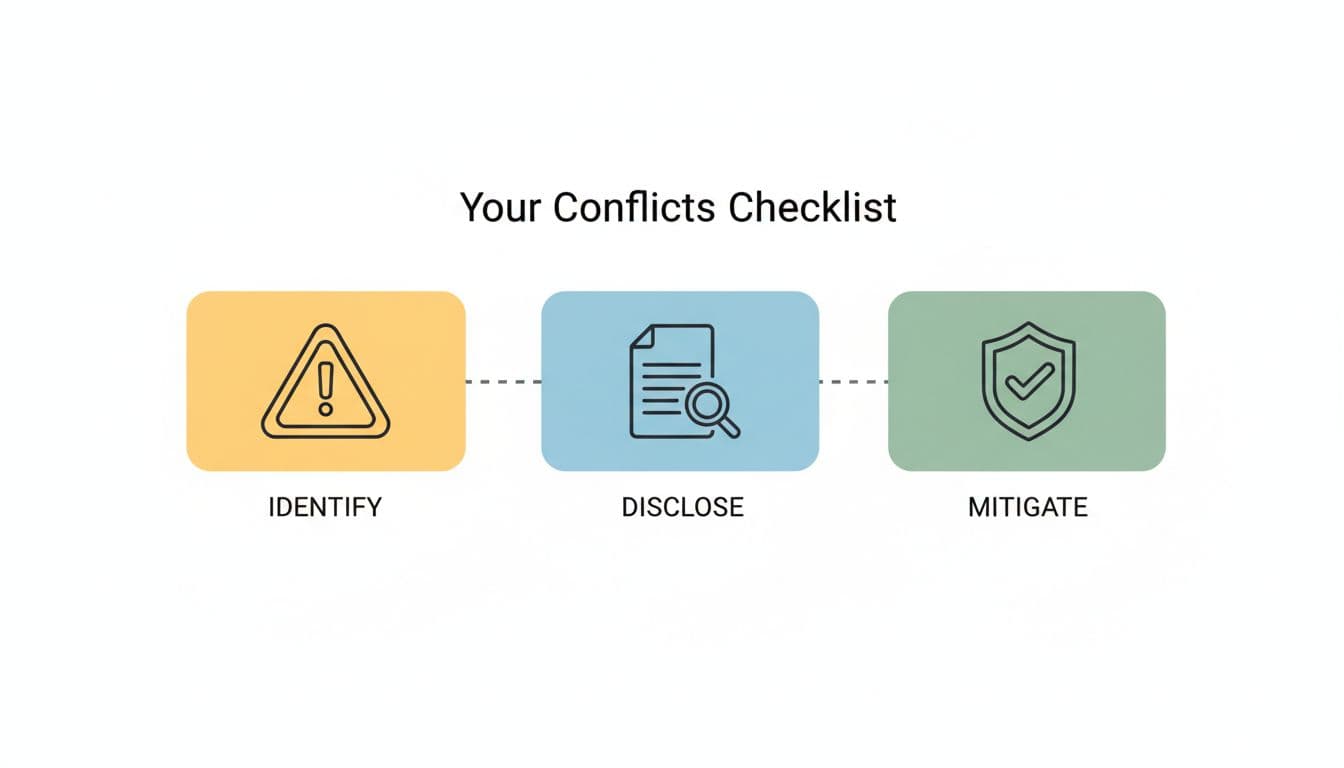
A practical checklist your team can use before submission
When deadlines bite, this is the section that gets rushed. Ironically, it’s also the section that can trigger clarifications or exclusion discussions.
Use these prompts in your final review to identify and mitigate conflicts of interest, and keep the answers short.
→ Who in our team has worked for, consulted with, or seconded into the buyer recently?
→ Have we been involved in any pre-market engagement linked to this tender notice or dynamic market notice for the public contract?
→ Do we have any subcontractors with buyer-side relationships we need to declare?
→ Could we have had access to information other bidders wouldn’t have?
→ If an auditor read this, would our mitigation look reasonable and recorded?
→ Have we matched the tender wording (conflict, perceived conflict, impartiality)?
→ Have we named who is excluded from what (calls, bid access, approvals)?
→ Is our statement consistent across SQ, ITT, and attachments?
One more tip that saves pain later: keep a simple “tender integrity note” in your bid folder. It’s just a record of what you declared and why. If clarifications land, you’ll answer in minutes, not hours.
Common mistakes that trigger clarifications (or make you look slippery)
This is where good organisations trip up, usually because they’re trying to be brief. Proper conflicts of interest declarations help prevent serious risks like fraud, bribery and corruption.
Being vague to “avoid drawing attention”
Perceived conflicts were relevant under the Public Contracts Regulations 2015 as well. The Procurement Act 2023 now places express identification, assessment and mitigation duties on contracting authorities. If the tender documents request disclosure of a relevant connection, answer fully and explain any practical controls.
Saying “no conflicts” when you mean “no actual conflicts”
Perceived conflicts of interest count. If you have a relationship that could look awkward, name it and neutralise it.
Copy-pasting a generic statement
Evaluators can tell. Worse, generic text can suggest an unfair advantage or contradict your own bid (for example, your case study names an authority contact, yet your conflict statement says “no relationships”).
Skipping mitigation details
A declaration without mitigation reads like: “We know this might be an issue, good luck.” Give them a control they can believe.
If you want a broader set of “this is quietly losing you marks” issues to fix, see common bid proposal mistakes to avoid. Conflicts usually sit in the same bucket as compliance and clarity: small sections, big consequences.
Conclusion: clear, honest, controlled
Conflicts of interest statements, formally known as a conflict of interest declaration, don’t need legal poetry. They need clarity, a sensible risk view, and a mitigation step that an evaluator can trust. These formal requirements under section 83 establish an ongoing duty to manage conflicts of interest that applies even to below-threshold procurements (and integrates with the transparency notice across the wider procurement lifecycle under the new Act).
If you want support before you hit submit, Bidsmithery™ can review your near-final draft the way an evaluator would (including the awkward bits like conflicts, governance, and compliance). You can also build team capability through Bid Win Rate Accelerator Training, or steady the workload with Bid Review retainer support.
Book a fit check call here: Fit Check call. If you’d like to know who’s behind the feedback, start here.

Meet the Author
Melissa is the founder of Bidsmithery™ with over 15 years of experience across bid writing, bid management and evaluation. Having sat on both sides of the process as both writer and evaluator, she works across sectors because great bids follow the same principles wherever you’re tendering. With more than £103M in contracts secured, she specialises in framework bids and strategic bid reviews helping organisations sharpen their approach when it really counts.