Is this tender worth bidding for? A practical decision test
Another tender opportunity has landed. The contract looks promising, but can your team deliver it, prove it and still meet Friday’s other deadlines?
A bid/no-bid decision gives you a way to answer before anyone starts drafting. It protects time for work you can win and deliver well. Start with the requirements that could rule you out.
How do you make a bid/no-bid decision on a tender?
A bid/no-bid decision is the point where you decide, deliberately, whether a tender (or a request for proposal) deserves your team’s time. Start with the checks that could rule you out, such as the qualification criteria, the mandatory requirements and whether you can actually deliver. If you get through those, weigh up your evidence and the competition, then look at the margin and whether the team has the capacity to write a good response.
If the checks support a bid, give it an owner and a realistic budget. If they don’t, write down why and move on. Either way, your leadership team ends up with a decision they can explain, based on more than the size of the contract.
Why this matters
A tender can absorb your delivery lead, finance person and senior team long before a writer opens the response document. Those people still have their usual work, including business development. The cost shows up in delayed decisions, stretched staff and bids assembled after hours.
A polished response cannot rescue a weak fit with the buyer’s evaluation criteria. Even a strong buyer relationship isn’t evidence of a strong scored response. Evaluators can only mark the evidence they find in your submission, however much expertise your team knows it has.
That is why a consistent decision matters to your win rate. You give stronger opportunities the attention they need, and stop spending your team’s energy on work you couldn’t price, evidence or deliver confidently.
If the only reason to bid is “we can’t afford to miss a contract this size”, check the delivery margin before you commit.
Screen out tenders you cannot bid or deliver
Before anyone gets attached to the opportunity, read the full pack together: the notice and instructions, the specification, the pricing schedule and the draft contract. A promising title can hide a mandatory accreditation, an awkward mobilisation date or a pricing model that changes the whole decision.
Check the hard requirements first
Your first pass should be short. Ask:
- Can we meet every mandatory condition by the stated deadline?
- Can we submit in the required format through the buyer’s portal?
- Are the required insurance, policies, accreditations and references available?
- Can we meet the contract terms, including obligations passed to a partner, and has our risk assessment covered these dependencies?
Keep mandatory conditions separate from scored criteria. A weak response against the evaluation criteria may cost marks; failing a pass/fail requirement may stop your bid progressing altogether. If a requirement is unclear, ask through the formal clarification route before treating your interpretation as fact.
Check the delivery reality
Who will do the work if you win? Who will mobilise it? A bid team may find time to describe delivery capability without the delivery team having capacity to spare.
Ask the person accountable for delivery to confirm who would staff it and where, what equipment and partners it relies on, and when it could realistically mobilise. If their answer depends on recruitment or a subcontractor, price and test that dependency now. “We’ll work it out after award” is an expensive sentence.
Score the tenders that pass
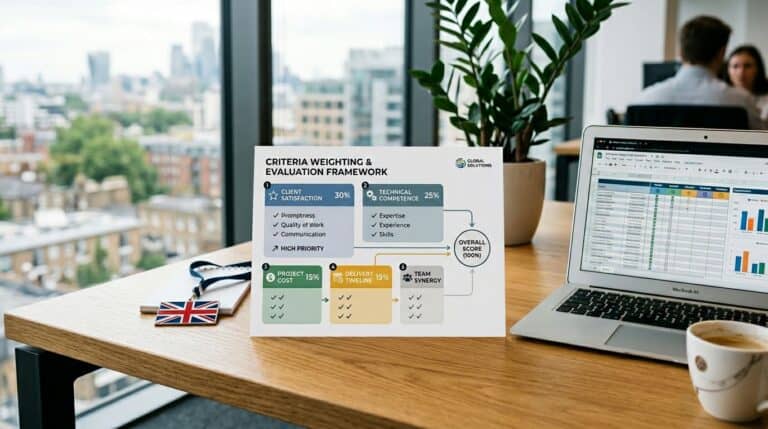
Once the hard requirements are met, use a decision matrix to make the discussion less dependent on whoever feels most enthusiastic. This scoring framework rates each factor from 0 to 5, where 0 means no credible case and 5 means a strong, evidenced fit.
Weight what matters to your business
Here is a starting model. Change the weights to match your contracts and appetite for risk.
| Factor | Weight | What you are testing |
|---|---|---|
| Evidence against award criteria | 25% | Can you prove the claims that earn marks against the evaluation criteria? |
| Commercial viability | 20% | Does your pricing strategy leave a workable margin after delivery costs? |
| Delivery capability | 20% | Can you mobilise and meet the scope? |
| Strategic alignment | 15% | Does this work suit your direction? |
| Competitive position | 10% | Can you offer a credible reason to choose you in the competitive landscape? |
| Bid team capacity | 10% | Can you produce and review a good response? |
Multiply each score by its weight, then divide the total by five. That gives you a result out of 100. Use it to bring disagreements into the open and spot what needs checking, before anyone starts treating it as a prediction of the outcome.
Require evidence behind the scores
Ask the person awarding each score to write one sentence explaining it. “Good relationship” is too thin. Relevant buyer discussions, previous contract performance or a clear understanding of the published requirement give you something to assess. Keep the scores and the reasons together somewhere the whole team can see them.
Score your evidence against the questions the buyer has actually asked. Can you produce figures, named examples and a delivery method an evaluator can follow? If the highest-weighted answer would rely on promises, lower the score.
Set your own point at which a bid needs senior review. Then use historical data from past wins and losses to see whether that threshold helps you make better decisions. A number pulled out of thin air deserves the same scrutiny as an optimistic sales forecast.
Test the true cost and likely return
A contract’s headline value tells you surprisingly little about whether the tender is worth bidding for. Assess its commercial viability by calculating a defensible delivery margin and setting a limit on bid costs.
Count the work before submission
Estimate how many hours the bid will take from everyone who touches it, including the bid lead, delivery specialists, finance and whoever signs it off. Use realistic internal costs, then add external support and other direct bid expenses.
Work backwards from the submission date. Leave time after the last answer is written to challenge the draft against the scoring criteria. If that window has already vanished, take it seriously. Planning around your tender review deadline helps you identify the decisions and checks that need space.
Whatever you use to track hours and approvals, the estimate is only as good as the numbers people give you.
Check what winning would cost
Test your price against the real cost of delivering, including recruitment, travel, suppliers and the management time the contract will need. A risk assessment should consider what happens if volumes are lower than expected or costs rise. The decision-maker needs a margin they can defend when costs start creeping up.
Agree your bid budget before the team starts work, covering internal hours, cash spend or both, and check in against it as the bid progresses.
Treat frameworks differently from single contracts
A single contract normally has a clear scope and award. A place on a multi-supplier framework may give you access to future work, but the advertised value is the ceiling for every supplier on it. Your share could be a fraction of that, or nothing at all.
Look at the route to actual work
Read the framework agreement and call-off rules. Can buyers award directly under the stated process, or will suppliers compete again through mini-competitions? How many suppliers may be appointed? Is any spending committed?
Price the effort to join and compete for call-offs. If each future opportunity needs another response, include that work in your commercial case. You’ll also need someone to watch for call-offs and keep pricing and evidence up to date.
Assess each lot on its own merits
Geographical and service lots can have different delivery demands, buyer priorities and margins. Score each lot separately, including its pricing, then test what happens if you win several. Your best evidence for one lot may be weak for another.
Before deciding, confirm whether you may bid for selected lots and whether the buyer limits the number it can award to one supplier. You’ll find these details in the procurement documents, so check there before assuming anything from the lot names.
Keep the decision workable for a small team
A small team can do this well with a repeatable conversation between the right people and a simple way of recording what was decided.
Give each person a clear call
The bid lead checks the instructions and scoring, while delivery confirms you can mobilise and do the work. Finance tests the price and the risk, and a senior leader makes the final call, including owning any exception to the normal rules.
Record the decision, main reasons, bid budget and next review point on one page. If a clarification changes the scope or price, reopen the decision. A “yes” made against an earlier version of the tender isn’t permanent permission to keep spending.
Separate the decision from the writing
If you bid, name the evidence owners and agree what a strong answer needs to show against the evaluation criteria before drafting starts. Developing tender win themes is useful at this point, when the team can still shape the response around the buyer’s criteria.
The writing can stay with your team whilst an independent reviewer tests what an evaluator can actually score. Insight from conversations with the buyer can shape the response, as long as it came through a permitted route. The marks still depend on what the evaluator can see on the page. Bidsmithery™ uses that evaluator-focused approach to find gaps in developed drafts without taking the decision out of your hands.
Common mistakes to avoid
The most costly errors often look reasonable in a busy pipeline:
- Deciding from the notice title without reading the pricing schedule and contract terms.
- Treating familiarity with the buyer as proof you will score well.
- Counting staff availability for the bid but ignoring availability for delivery.
- Using framework ceiling values as expected revenue.
- Assuming a weak answer can be fixed during final proofing.
- Continuing because the team has already spent time on the tender.
Another mistake is confusing publication rules with a guarantee of an open competition. For covered public procurements in England, Wales and Northern Ireland, contracts at or above the applicable threshold follow the relevant formal rules, but an open tender is not the only possible route. PPN 023 sets out the 2026 threshold amounts. Below-threshold contracts have their own rules, explained in the government’s below-threshold guidance. Scotland has separate procurement arrangements. Check the live notice and documents before planning your response.
Act on the decision and learn from the result
The point of qualification is to change what your team does next.
If the answer is no
If the buyer has approached you directly through a permitted route, reply promptly and politely. Thank them, decline the opportunity and preserve the buyer relationship where appropriate. Keep your internal scoring and any thoughts on the specification to yourself.
For public opportunities found on Find a Tender, record why you passed. A UK1 pipeline notice gives you an earlier opportunity to assess fit; a UK4 tender notice means the live competition has arrived. Either way, a useful “no” helps you recognise a better-fit opportunity later.
If the answer is yes
Assign owners, confirm the budget and set review dates as part of your proposal management. Use a bid review checklist to check compliance, clarity and evidence in your tender response before submission. If you lose, request feedback where available and compare it with your original decision scores.
Use historical data to check whether your assessment of the evidence and competitive position was accurate. Include bid costs, feedback and results in your win-loss analysis, then update your weights and thresholds. A decision process earns its keep when the next decision gets sharper.
Frequently asked questions
Conclusion
The next tender may look too valuable to refuse. Before you say yes, check the conditions, the evidence, the margin and the people who would deliver it. A clear go/no-go decision gives a good opportunity the attention it deserves.
Make the next decision easier
If your team keeps facing the same difficult decision under deadline pressure, Bidsmithery™ can help through Bid Win Rate Accelerator Training or an ongoing bid review service. You can also book a fit check call to discuss what suits your pipeline.
Key takeaways
A tender is worth bidding for when you can meet its conditions, show evidence against the scored criteria, deliver profitably and give the response proper attention. Record why you chose to bid or pass, then use the result to make your next decision stronger.

Meet the Author
Melissa is the founder of Bidsmithery™ with over 15 years of experience across bid writing, bid management and evaluation. Having sat on both sides of the process as both writer and evaluator, she works across sectors because great bids follow the same principles wherever you’re tendering. With more than £103M in contracts secured, she specialises in framework bids and strategic bid reviews helping organisations sharpen their approach when it really counts.