
Tender interviews: what evaluators are really looking for
Made the shortlist, but unsure what the panel will ask? Worried your delivery team will promise something the bid never included?
Tender interviews call for clear evidence and answers your team has agreed in advance, so the evaluators come away confident you can deliver. The place to start is working out exactly what the buyer will assess.
What are tender interviews?
A tender interview is a meeting run by the buyer where shortlisted suppliers explain their approach and answer questions about how they’d deliver. It might include a presentation, a technical discussion or questions about the bid you’ve already submitted.
Evaluators want answers that meet the published requirements and are backed by credible evidence. They also want to see who is responsible for what, and that everything lines up with your written offer. Check the tender pack to see whether the interview carries its own marks or is there to clarify answers you’ve already given.
Good preparation links the scoring rules to the people who’ll speak and the commitments you can stand behind. That gives your team a clear way to prepare without every evening turning into another rehearsal.
Key takeaways
- Check the invitation and tender documents to understand what the interview assesses, how it is scored and what the process permits.
- Give clear answers backed by evidence that match the written offer. Explain who owns delivery, what happens in practice and how you’ll manage risk.
- Prepare for questions on delivery, performance, social value and pricing, including assumptions and the limits of your commitments.
- Use a shared briefing sheet and focused rehearsals to agree responsibilities and practise challenging questions without relying on identical scripts.
- Don’t guess or make new promises under pressure. Credible, consistent answers make your offer easier to understand and score.
How are tender interviews scored?
Check the invitation before opening PowerPoint. Is the meeting a scored assessment, a clarification exercise or a discussion before final tenders?
Each of those needs a different approach. A scored presentation may carry its own weighting, while a clarification exercise usually helps the buyer understand a response you’ve already given and won’t let you rewrite it.
The government’s guidance on assessing competitive tenders explains how award criteria and assessment methods work in public procurement. Whatever you prepare needs to follow the method published for this particular tender.
Confirm what will be assessed and how the interview marks combine with your written scores. Check too whether there’s a minimum quality score you have to reach. If the documents leave any of this unclear, ask through the stated clarification route.
From an evaluator’s side, I need reasons I can record against the criteria. A confident team helps, and evidence is what makes that confidence count.
It’s worth understanding how tender evaluation criteria work, because a reassuring conversation and an answer that earns marks can feel very similar in the room.
Which procurement rules apply?
The Procurement Act 2023 came into force on 24 February 2025. Procurements that started under the old rules generally carry on under them, and Scotland has its own legislation.
From 1 January 2026, standard goods and services thresholds are £135,018 for central government and £207,720 for sub-central authorities, including VAT. The works threshold is £5,193,000 including VAT.
The 2026 procurement thresholds depend on the type of buyer and contract, and other contract categories have their own figures.
Above the relevant threshold, buyers normally need a compliant competitive route unless a lawful exception applies or they’re using an existing agreement. Smaller contracts can still come with advertising and competition duties.
For your interview, the useful questions are which rules this procurement sits under and what stage you’ve reached. If it’s a framework mini-competition, where suppliers already on a framework compete for a specific piece of work, the framework’s own award process sets the rules for the interview too.
Talking about your offer before a final tender is treated differently from clarifying a bid you’ve already submitted. The Procurement Act guidance collection gives the wider picture, and the live tender documents tell you what applies here.
If the invitation is to discuss your offer, check whether negotiation is actually permitted before your team walks in ready to haggle.
What evaluators need to hear from your team
Having written and evaluated bids, I look for whether the proposed service holds together when someone asks a practical question.
“We have an experienced team and robust processes” leaves a lot unanswered.
Who starts the work? What happens first? Which decisions need the buyer’s approval? What happens if the recruitment process takes longer than expected, and what response has the team agreed?
Mobilisation is the period of setting up the contract before normal delivery starts. Explain what it depends on and who is responsible, including staffing, systems access, handover, training and the checks that confirm you’re ready.
A stronger answer identifies the responsible role, the decision point and the response if something slips. Use the actual plan your team has agreed.
What I would be looking for is a plan the delivery team recognises and can explain without reading every word.
A case study earns its place when it proves something relevant.
Explain which parts of the previous contract were comparable: service scope, staffing demands, reporting requirements or delivery risks. Then state the result you can substantiate.
Be honest about the limits too. Running a smaller service might support your approach, and the panel will still want to know how you’d handle the extra scale.
Prepare the source behind each important claim. That might be a performance report, client reference or documented improvement.
The panel may ask what went wrong as well as what went well. A straight answer about how you put it right is far more convincing, because every evaluator knows delivery sometimes gets difficult.
Which tender interview questions should you prepare for?
Pick the questions the buyer is most likely to ask and practise those properly. A long bank of generic answers is hard to remember and rarely fits the question on the day.
Expect questions such as: “What could delay the start date?” or “How will you respond if performance falls below target?”
Your answer should cover the action, the person responsible, how you’ll monitor it and the escalation route. Escalation simply means who picks up an issue when the delivery team can’t resolve it.
For social value, explain the additional contract-linked benefit you have offered, who owns it and how it will be measured.
Where I see bidders lose marks is the gap between an attractive commitment and an operational answer. “We’ll work closely with you” doesn’t tell the buyer how a missed target gets corrected.
Ask your delivery lead to challenge every promise before the panel does.
Be ready to explain how your price supports delivery, including staffing, mobilisation and contract management.
Check the published price formula. Where it is lowest compliant price divided by your price, multiplied by a 40-point weighting, £80,000 receives 40 points. A £100,000 offer receives 32.
That eight-point gap has to be weighed against the quality marks available, and a strong interview can only close so much of it.
Know which costs depend on volumes, buyer inputs or stated assumptions. If asked about additional work, explain the cost implications and stay within the submitted offer and permitted process.
An unpriced promise made under pressure can undermine both your margin and your credibility.
How to prepare without overloading your team
Your team is probably preparing around live delivery, so keep the work focused on what the panel needs to understand.
For each criterion, note its weighting, the evidence you’ll use and the lead speaker. Add the follow-up questions you think are likely.
Then add the commitments you’ve approved and where their limits sit, covering start dates, staffing, service levels, reporting and pricing assumptions.
Focused interviews with subject matter experts are a good way to uncover missing delivery detail. Ask them for proof and practical explanations, and leave the polished paragraphs for later.
Then agree who answers operational, financial and contractual questions. The person best placed to answer should take the question, whatever their job title.
Your delivery lead should have room to demonstrate ownership. Your senior sponsor can explain governance and decisions that need authority.
Ask a colleague to play the mock interviewer. They should interrupt, challenge your assumptions and push for evidence.
A useful sequence is: answer the question, explain the method, give relevant proof, then connect it to this contract.
Before the meeting:
- Confirm the format, timing, attendee limit and permitted materials.
- Check spoken commitments against the submitted bid and price.
- Allocate questions and practise clean speaker handovers.
- Test the technology and keep an accessible backup.
- Agree how to handle questions that require formal clarification.
Your team needs a shared understanding of the answers, and nobody needs to recite a script. It’s fine to pause and think. A considered answer lands better than filling every silence with another promise.
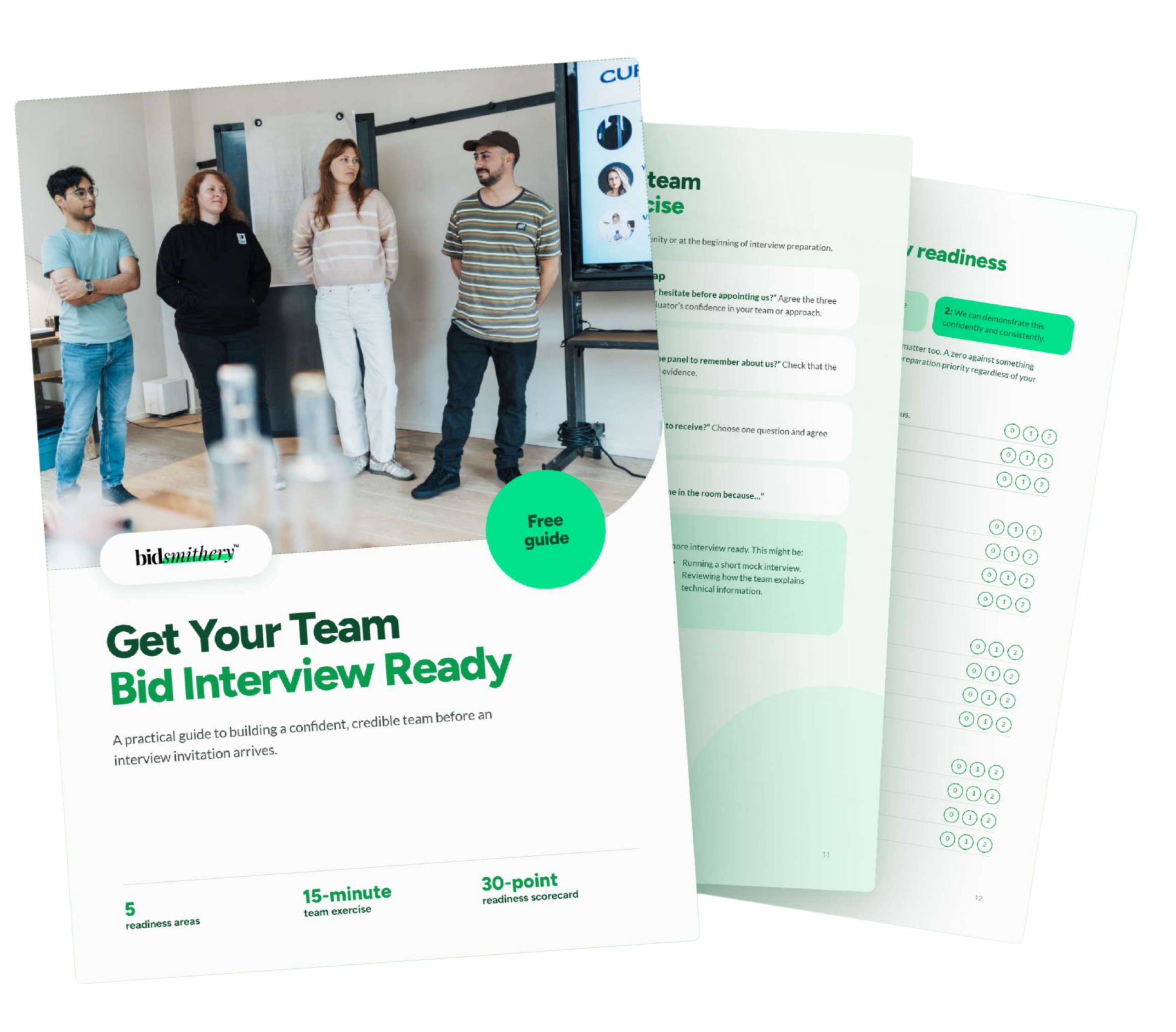
Free guide: Get Your Team Bid Interview Ready
If your interview is coming up, this guide walks your team through five readiness areas. It includes a 15-minute team exercise and a 30-point scorecard, so you can see where the gaps are before the panel does.
Common mistakes that weaken evaluator confidence
Letting answers drift away from the bid creates avoidable doubt. If the written offer gives one timescale and the presenter gives another, the buyer needs to establish which commitment applies.
Overloading the session with company history wastes time when the brief asks for delivery detail. Keep background short and relevant.
Another mistake is having one confident speaker answer everything. If the contract manager cannot explain performance reporting, the panel may question who will run the work.
Treat a tough question as a chance to show your thinking. A question about contingency cover is often an invitation to explain a sensible control.
If a detail needs confirming, say so and follow the permitted route. Guessing is risky, and you can’t assume the buyer will accept further evidence afterwards.
Finally, avoid rescuing an unsupported claim with a larger claim. If you cannot substantiate “excellent outcomes”, adding “sector-leading” won’t help the evaluator record a defensible score.
Frequently asked questions
Make your delivery plan easier to trust
The strongest preparation connects the scoring criteria, your evidence and the people responsible for delivery. Everyone in the room should know what has been promised and be able to explain how it will happen. If you want a structured way to get there, our free guide Get Your Team Bid Interview Ready walks you through it.
Keep the focus on evaluator confidence, and make your offer easy to understand, check and score while staying within the buyer’s process.
If you’d like support with your actual team before the interview, I can work with them directly through Bidsmithery™’s bid consultancy. Get in touch and we’ll talk through what your team needs.

Meet the Author
Melissa is the founder of Bidsmithery™ with over 15 years of experience across bid writing, bid management and evaluation. Having sat on both sides of the process as both writer and evaluator, she works across sectors because great bids follow the same principles wherever you’re tendering. With more than £103M in contracts secured, she specialises in framework bids and strategic bid reviews helping organisations sharpen their approach when it really counts.