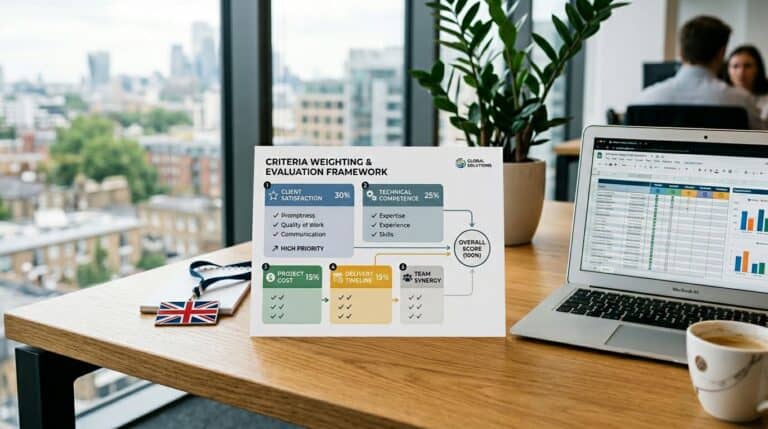


Tender evaluation: what happens after you submit?
You’ve pressed submit, the portal has sent its receipt, and now the waiting starts. Knowing what’s happening on the other side helps you handle clarifications, read your feedback properly and plan the next bid.
I’ve spent years on the evaluating side as well as the writing side, so this guide walks through each stage in the order the buyer works through it.
What is tender evaluation?
Tender evaluation is the structured assessment of supplier bids against published evaluation criteria to identify the best value for money.
The buyer checks compliance, scores eligible responses, applies price and quality weightings, resolves permitted clarifications and agrees the outcome. The buyer should be able to support its decision with evidence and written reasons for every score.
For you, the useful questions are how marks are awarded, what happens during moderation and what the result tells you.
Key takeaways
- The buyer checks compliance, then scores eligible bids against the published criteria and weightings. Meeting a mandatory requirement doesn’t earn quality marks by itself.
- Evaluators assess evidence against the published descriptors. Price formulas and quality weightings determine how each score affects the total.
- Clarifications can resolve uncertainties in your submitted offer, but they shouldn’t let you replace a weak answer after the deadline. Moderation should produce a consensus score supported by evidence.
- Keep your submitted files and clarification records. When the result arrives, compare the feedback with your answer and the published criteria, and check which standstill rules apply to the procurement.
Step 1: Compliance checks and the evaluation team
Does your bid meet the entry requirements?
The buyer first establishes whether your submission can progress. This can include mandatory documents, exclusion grounds, financial standing and conditions of participation, meaning requirements suppliers must meet to compete.
Meeting a mandatory requirement keeps you in the competition, but it won’t usually earn you any quality marks on its own.
Above the applicable public procurement thresholds, covered public contracts generally require competitive tendering unless a direct-award exception applies. Below-threshold buyers may still tender under their own rules.
Who evaluates the tender?
The team should have financial, technical, purchasing and legal expertise available. Different people may assess different parts of your offer.
Typically a technical evaluator looks at delivery, finance reviews pricing and commercial assumptions, and procurement runs the process with legal input where it’s needed.
They need enough information to assess your submission fairly. They shouldn’t have to supply missing detail from their own knowledge of your organisation.
Step 2: Apply the published criteria and weightings
What can the buyer score?
Evaluation criteria, including award criteria, can cover delivery, staffing, contract management, price, risk and social value. They must relate to the contract, be clear and measurable, remain proportionate and avoid discrimination.
The government’s guidance on assessing competitive tenders sets out these requirements.
Under the Public Contracts Regulations 2015, the award test was the most economically advantageous tender, or MEAT. The Procurement Act 2023 uses most advantageous tender.
Buyers tend to keep the main criteria to a manageable number, often around five, although there’s no fixed UK limit.
How much does price matter?
The published weighting determines how much the weighted criteria affect the result. A 60% quality and 40% price split gives quality more scope than the reverse.
Models vary between buyers, and some don’t give the cheapest bid full price marks, so read the pricing method as carefully as the quality questions.
Step 3: Score quality and calculate price points
How are quality marks awarded?
Evaluators normally score independently against the published descriptors, which define each available score.
A descriptor such as “Insufficient evidence that the contract can be fulfilled” gives a clearer basis for judgement than “Below par”.
On a 0-10 scale, the tender documents should explain what each available score means. Eight in one procurement doesn’t necessarily mean the same as eight elsewhere.
Mixed-quality bids receive mixed scores. A strong staffing answer can’t make up for a weak mobilisation answer, which explains how you’ll get the service ready to start.
Our guide to reviewing tender scoring criteria helps you test each response separately.
How does the price formula work?
One common formula is:
Price score = 10 × lowest compliant tender price ÷ your tender price
Using compliant prices of £80,000 and £100,000, the £100,000 bid receives 8/10. With price weighted at 40%, that becomes 32/40.
The scoring below shows how those results combine under the weighted criteria.
| Component | Available points | Calculation | Weighted points |
|---|---|---|---|
| Quality | 60 | 8 ÷ 10 × 60 | 48 |
| Price | 40 | £80,000 ÷ £100,000 × 40 | 32 |
| Total | 100 | 48 + 32 | 80 |
The £80,000 bid receives all 40 price points. The higher-priced bidder needs a quality advantage greater than eight weighted points to overtake it.
Change price weighting to 60%, and those price scores become 60 and 48. The price gap grows to 12 points. That’s the same formula carrying far more weight in the final result.
Step 4: Clarify uncertainties and moderate scores
What happens if the buyer asks a question?
A clarification request asks you to explain something unclear in your submission, so keep your reply to that point and resist the urge to improve the whole answer.
Questions and responses should be written, recorded and handled consistently, without giving a bidder an unfair competitive advantage.
Answer the point asked. Keep your response consistent with the submitted offer, including staffing, price and delivery assumptions. Relevant clarification questions and answers should be incorporated into the final contract.
A request means the buyer needs something resolved, and it gives no hint about where you’re ranked.
What is moderation?
Moderation brings evaluators together to review their independent scores and reasoning. Good practice uses a moderator outside the original scoring team.
They return to the answer, evidence and descriptor to agree a defensible consensus score.
If evaluators award 6 and 8, moderation may not land on 7, because the panel agrees the score through discussion. The evidence may justify either original score.
What I would be looking for is a clear reason for the final mark. The loudest voice in the meeting shouldn’t decide it.
For social value, “we support local communities” gives little to assess. Funded commitments, delivery responsibilities and measurable reporting give evaluators something firmer to judge.
Step 5: Record the decision and notify bidders
What records support the award?
The evaluation report should explain how the criteria were applied, how scores were calculated and why the selected tender ranked highest.
The audit trail should include submitted bids, individual scoring notes, moderation records, calculations, clarifications and approvals.
Under section 98 of the Procurement Act, records explaining material decisions must be kept for at least three years from the day the contract is entered into. Other obligations may require longer retention.
These records help explain the decision during a debrief, information request or legal challenge. Your team should also retain the exact submitted version.
How long is the standstill period?
Standstill is the pause before the buyer enters into the contract.
For procurements under PCR 2015, electronically sent award notifications generally trigger a minimum 10-calendar-day period, counted from the following day.
Under the Procurement Act 2023, mandatory standstill is eight working days, beginning with publication of the contract award notice. Assessment summaries go to assessed suppliers before that notice.
Exceptions apply, including framework call-offs under the Act. Those are contracts awarded through an existing framework agreement.
New covered procurements in England, Wales and Northern Ireland have used the Act since 24th February 2025. Earlier procurements continue under their previous rules. Scotland has separate legislation.
Common mistakes that cost bidders marks
A familiar weakness is assuming the evaluator will connect the dots. Your team understands the service because it delivers it. The submitted answer still needs to explain the method, responsibilities and evidence.
“We have experienced staff” is a claim. Relevant qualifications, comparable delivery experience and clear deployment arrangements give that claim substance.
Another mistake is treating every question as equally important. A low-weight answer deserves attention, but it shouldn’t consume the review time needed for a heavily weighted delivery question.
Social value promises also need scrutiny. Commitments should relate to this contract, be deliverable and have costs accounted for.
Finally, don’t turn every debrief comment into a permanent writing rule. Some feedback points to a weakness that keeps coming up, while some only reflects what one buyer wanted, and it’s worth treating those differently.
Your post-submission checklist
While the buyer evaluates, keep the opportunity organised without trying to reopen your bid.
- Save the final submitted files, pricing workbook and submission receipt together.
- Give one person responsibility for monitoring portal messages and clarification deadlines.
- Respond through the requested channel, with the right delivery or finance input.
- Keep a record of every clarification and any commitment it confirms.
- When the result arrives, compare each score and comment with the submitted answer.
Look for the reason behind the mark. Missing evidence needs a different fix from an unclear explanation or a pricing disadvantage.
Our bid debrief and feedback review helps separate practical improvements from opportunity-specific comments and inconsistencies that deserve attention.
Frequently asked questions
Make the next submission easier to score
Tender evaluation rewards answers the buyer can understand, evidence and defend against the published criteria. A strong service needs a written response that makes those strengths assessable.
At Bidsmithery™, we help teams review clarity, evidence and scoring logic while keeping their knowledge and control in-house.
If you’re left with scores but little direction, our debrief support can help turn the result into a practical plan for your next bid.
Related reading
→ Post-tender clarifications: what buyers can ask

Meet the author
Melissa Howard knows what evaluators look for, because she’s been one. She founded Bidsmithery™ after 15 years writing, managing and scoring bids across more than 10 sectors, and in the past three years her clients have won more than £103m in contracts.
The Bidsmithery™ secret sauce is simple: your team writes the bid, and Melissa reviews it before you submit, showing you where you’re losing marks and how to fix them. She also trains teams, so every bid gets easier.